


Welcome to the latest edition of The API Economy. Thanks for being here.
To support the API Economy, join the 11,503 early, forward-thinking people who subscribe for insights on the forefront of technology, crypto, AI, and other emerging trends.
For more than two decades, software has mostly helped people do better work. It made individuals and teams more productive. It organized information, streamlined workflows, and reduced friction. That was enough to build an industry worth trillions.
But now everything is changing
AI agents are beginning to take on work that once required people to log into tools. These agents operate continuously, interact through APIs, and execute tasks without screens, approvals, or manual intervention.
On the All In podcast this week, David Friedberg discussed what’s been happening in SaaS over the past 2-3 months:
“My experience lately, in just the last 60 to 90 days (with the tools we’ve been talking about broadly), is that there are things we can get done now that we could not get done before. And so I think about software in the past, it’s like worker productivity enhancement. It helps people do work, and the recent transition that a lot of people talk about is that it actually does the work. It does the work (these agents or what have you), but I think that what we’re starting to lean into is it’s doing the work that the humans can’t do. And that’s really where I think the power of these tools starts to force a transition in both the pricing model and the value creation potential in front of us.
Number one, I think the value creation potential in front of us is so significant that I would say that you can probably take the sum of the market cap of all the software companies today and have a pretty good bet that everything will be 4x to 10x higher five years from now, but it’s not going to be evenly distributed. The companies that figure out how to realize that value creation are going to be outsized returns.”
Software is becoming clearly less dependent on human attention and more dependent on machine execution.
Recent Goldman Sachs Research projects AI agents are set to take over the profit pool in software, while also making the total addressable market for SaaS profits even larger.
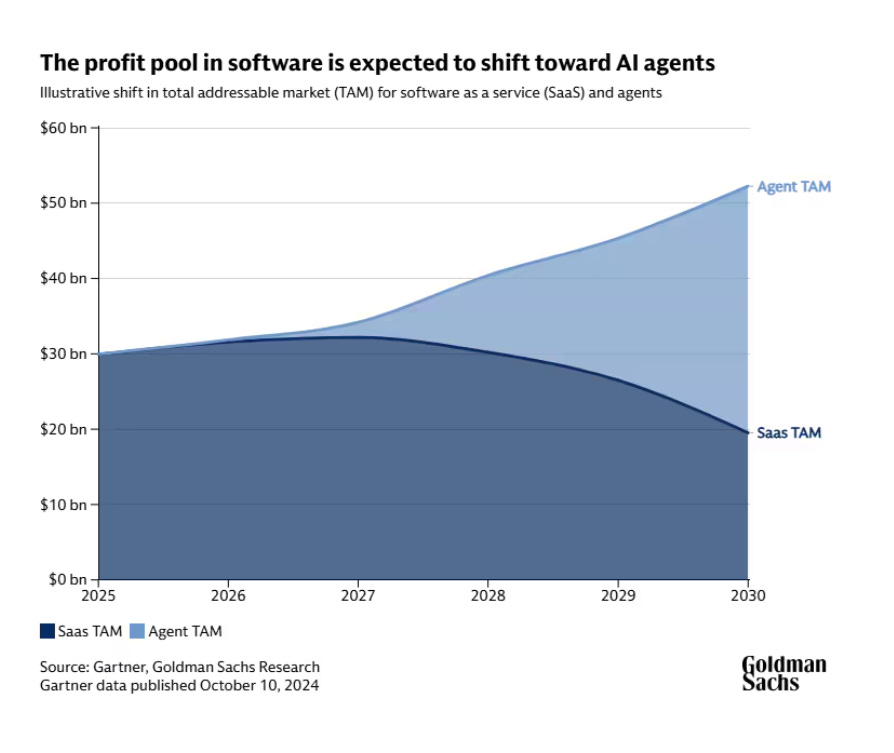
Agents are expected to account for more than 60% of software economics by 2030, meaning the majority of value will flow to agentic workloads rather than traditional per-seat SaaS.
This helps explain the tension many companies are feeling right now: the gap between knowing the world is changing and knowing what to do about it. For the companies that pivot fast and stick the landing, agents produce what feels like the next stage of growth. For everyone else, the clock is ticking to figure it out.
Steven Sinofsky captures the opportunity for software in his article, ‘Death of Software. Nah.’
“The number of processes and experiences in work and life that are not yet fundamentally improved by software is far greater than the number that have been improved by software.”
The next phase of software is going to look dramatically different. And while it feels like everyone knows that, it seems like few know what to do about it.
Every Software Company Is Now an API Company
The most important changes in software today are how it is being built and how it is being consumed.
Let’s start with how software is being built.
AI is now directly involved in producing software. Developers are no longer writing every line by hand. They are describing intent, reviewing outputs, and orchestrating systems that generate, test, and deploy code continuously.
As Dylan Patel recently noted, a growing share of software is now being built with AI in the loop, with 4% of GitHub public commits now being authored by Claude Code.
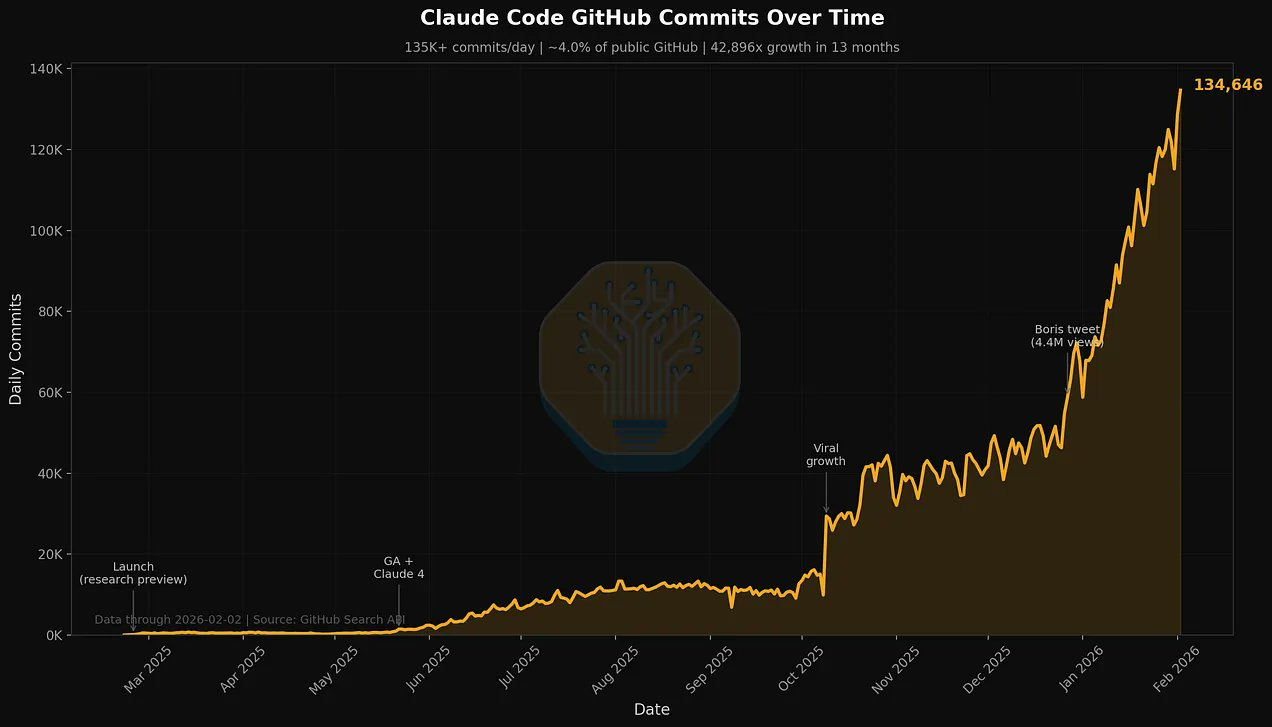
This changes the economics of creation. When the cost of writing software falls, supply increases. When supply increases, software stops being scarce.
For most of the SaaS era, scarcity lived on the supply side. Skilled engineers were expensive. Building reliable systems took time. Shipping software was the hard part.
That is no longer the primary constraint.
At the same time that software is becoming cheaper and faster to build, it is also being consumed in a fundamentally different way.
Over the past year, coding productivity has increased sharply. Across multiple indicators, output has surged after years of relatively steady growth. New websites are launching faster. New mobile apps are shipping at higher rates. GitHub code contributions in major markets have accelerated meaningfully.
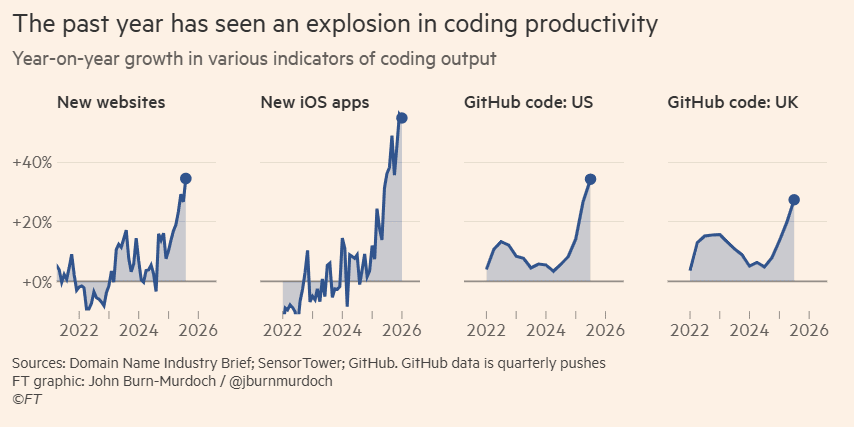
At the same time, software is becoming cheaper and faster to build. It is also being consumed in a fundamentally different way.
AI agents no longer wait for human input. They are active consumers of software. They call APIs, trigger workflows, coordinate systems, and execute tasks continuously. They do not interact with interfaces. They integrate directly with functionality.
Here is where the two shifts reinforce each other.
AI-assisted development increases the amount of software available. Agent-driven consumption increases how much software can be used. Together, they create a feedback loop where more software enables more execution, which in turn creates demand for even more software.
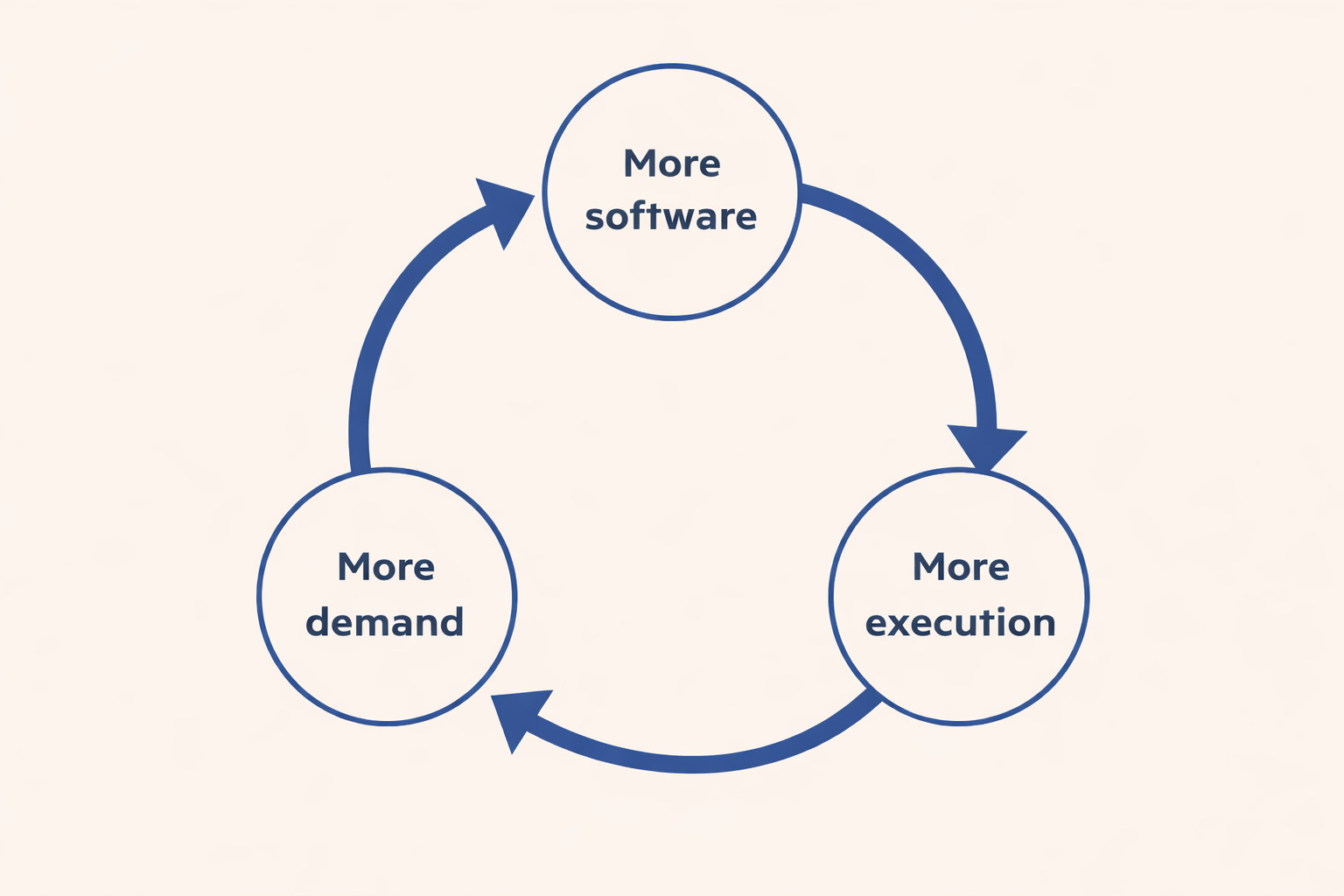
Once this flywheel spins up, the interface-centered SaaS model breaks down.
Interfaces were the choke point when humans were the users. Dashboards, menus, and workflows mattered because they mediated access to functionality. When agents become the primary users, interfaces become overhead. APIs become the surface area that matters.
Software that is easy to generate but hard to integrate fades quickly. Software that is hard to generate, but easy to integrate compounds.
Shallow SaaS products will feel the pressure first. When AI can generate alternatives quickly, and agents can consume them programmatically, differentiation based on interface design collapses. Value concentrates on reliability, composability, and depth of integration.
This is the trajectory: software increasingly looks less like a product and more like infrastructure.
You can hear this shift in the language that founders and operators are already using. When asked on TBPN whether software is dead, Sam Altman put it simply:
“Every company is now an API company, whether they want to be or not.”
When software is consumed by machines, it fades into the background. It becomes something other systems depend on rather than something people actively use. Reliability matters more than features. Latency matters more than layout. Backward compatibility matters more than novelty.
Add it all up, and the shape of the software economy is changing.
Creation is becoming abundant. Execution is becoming continuous. The constraint is shifting from building features to enabling scale.
This is the deeper reason why SaaS as we know it is breaking. The old model assumed scarce developers and scarce human attention. The new model assumes abundant code and machine-native consumption.
A Golden Age of Software
The temptation is to read all of this as disruption—or worse, displacement. That would be the wrong conclusion. This is not the end of software. It is the beginning of what software can really do.
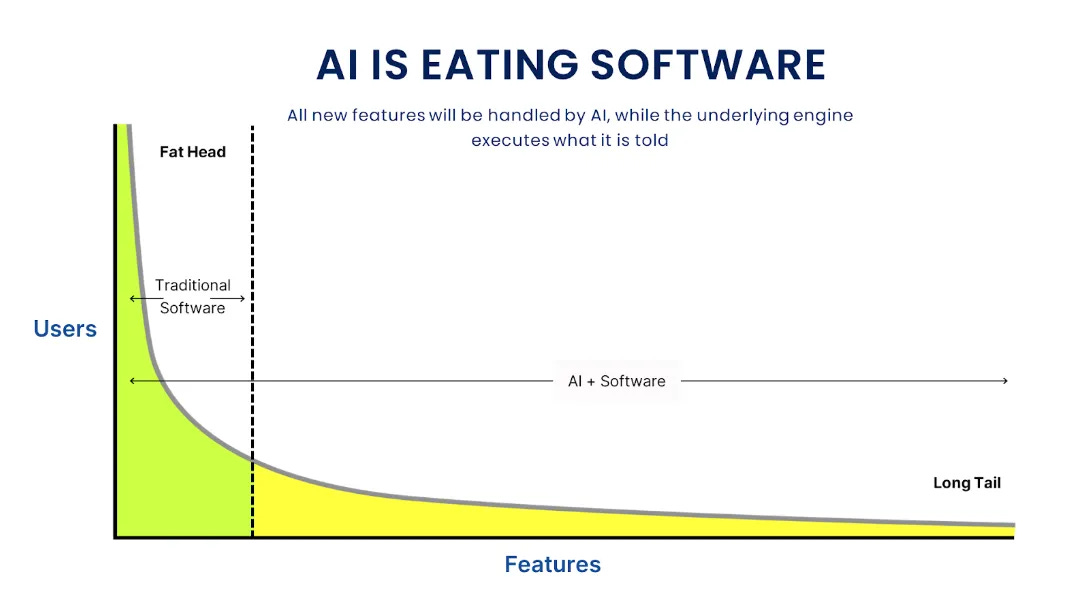
Software is entering a phase of near-infinite abundance. The cost to create it is falling. The ability to execute it is scaling. And the number of problems it can realistically tackle is growing faster than at any point in history.
Agents allow software to do work directly, continuously, and at a scale humans never could. They unlock use cases that were previously too expensive, too complex, or too slow to automate. They expand the surface area of what software can touch.
The opportunity ahead is enormous, but it demands adaptation. Pricing models will shift from seats to usage. Interfaces will matter less than integration. Reliability, composability, and trust will matter more than feature velocity. Teams will need to rethink how they build, sell, and operate software in a world where machines are the primary users.
It won’t be easy. Large organizations will move slowly. Legacy systems will persist. Hybrid models will dominate for years. But the direction is unmistakable.
Every software company now faces the same question: What role do we play in a world where software is abundant, and execution is continuous?
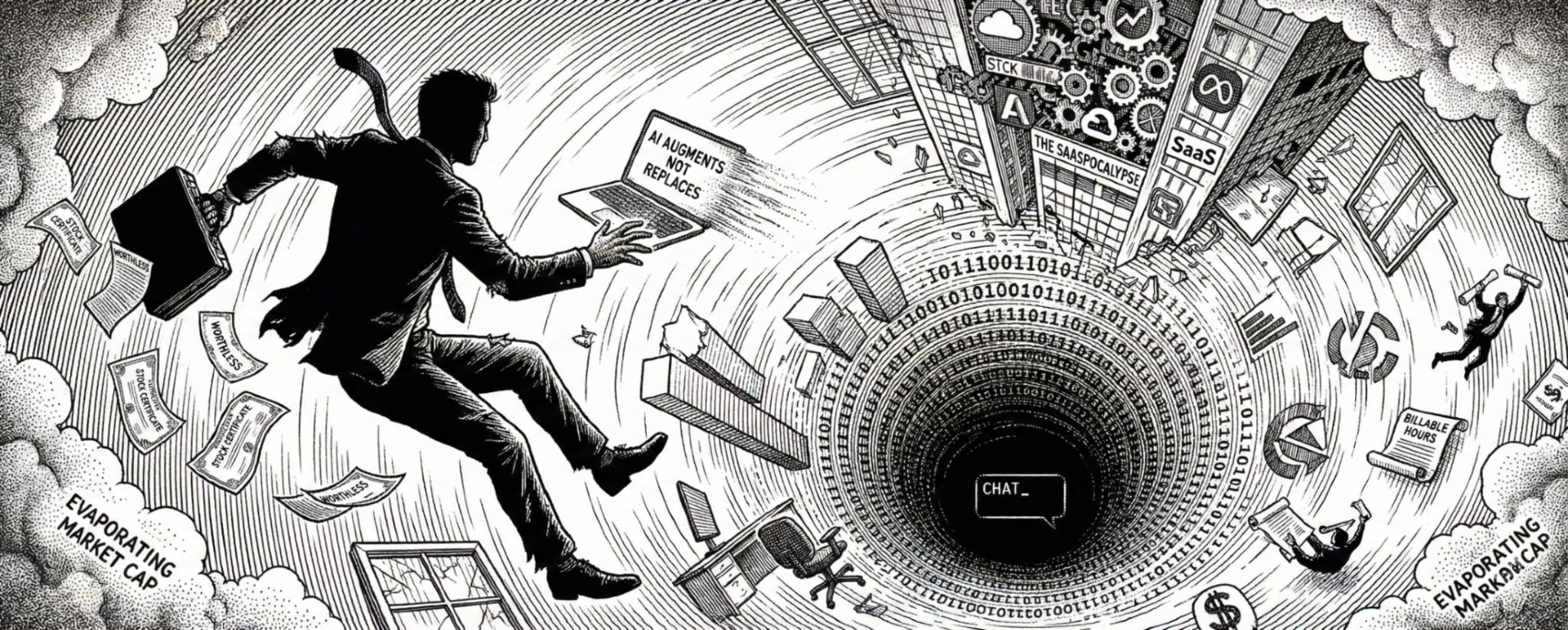
The companies that answer that question well will win. Not because they move the fastest, but because they align with how software is actually being built and consumed.
This is a rare moment where the fundamentals of technology and the fundamentals of business shift at the same time. When that happens, entirely new categories form. Old assumptions break. And value is created at a scale that is hard to comprehend in advance.
We are living through the most consequential shift in software since the internet. Act accordingly.
Until our next adventure.
Disclaimer: This month’s edition of The API Economy has no direct affiliation with Circle or any other company mentioned. I am employed by Circle at the time of this writing, but the views in this essay are my own personal opinions and don’t necessarily represent the views of Circle.
*Special thanks to Mama Schroeder for editing this essay (any typos are on her 😊).
You are correct that software pricing will go from seat to usage (or outcome) based, but consider that this will create a natural push back on thr pace of AI adoption. Agent based software is volume inefficient (wants and needs to constantly consume and refine). This will force users to throttle back or remove low value agents. Software is not dead, just evolving.