


Welcome to the latest edition of The API Economy. Thanks for being here.
To support the API Economy, join the 12,851 early, forward-thinking people who subscribe for insights on the forefront of technology, crypto, AI, and other emerging trends.
For most of modern economic history, information has moved much faster than value. The internet made information globally accessible in milliseconds, cloud computing made computation available on demand, and APIs allowed software systems to coordinate in real time. The financial infrastructure underneath that software economy went years without an equivalent transformation.
The difference is visible in the basic mechanics of markets. According to Charles Schwab, most U.S. securities still settle one business day after a trade, even after the SEC shortened the standard settlement cycle from T+2 to T+1 in May 2024.
Capital therefore spends a surprising amount of its life at rest. For example, money waits for settlement, collateral waits for reconciliation, securities wait for markets to open, and small transactions never occur because the administrative costs associated with them exceed the economic value being exchanged.
These frictions are easy to mistake for immutable features of finance because they have existed for so long. In reality, many are consequences of an architecture designed around institutions, separate ledgers, and human operating speeds.
Blockchains change the architecture of capital by allowing assets to exist on shared, programmable settlement rails. AI changes the architecture of coordination by allowing software to search, evaluate, decide, and act on economic information.
Velocity is the hidden denominator of efficiency. As the time required to decide, transact, settle, and redeploy approaches machine timescales, the same stock of resources can support much more economic activity.
In today’s essay, we will break down the velocity of money, the velocity of assets, the velocity of intelligence, and how it all comes together.
The Velocity of Money
Economists have long measured the velocity of money, which describes how frequently a unit of money is used to support economic activity. The Federal Reserve calculates M2 velocity as nominal GDP divided by the average stock of M2.
In the second quarter of 2026, U.S. M2 velocity stood at 1.412, while the M2 money stock itself reached approximately $23.2 trillion in June.
The concept is important because the productive capacity of money depends on more than its quantity. A dollar that can be deployed, settled, and redeployed repeatedly has greater economic utility than a dollar that spends long periods trapped between transactions.
Jeremy Allaire begins the monetary section of The Agentic Economy with a concise formulation:
“Begin with velocity, because it reorganizes everything else.”
He argues that digital money becomes qualitatively different when the marginal cost of storing and moving it falls toward zero, settlement occurs on machine timescales, and software can control it directly. Under those conditions, the same unit of money can participate in many economic activities in rapid succession.
Stablecoins provide the largest working example of this idea.
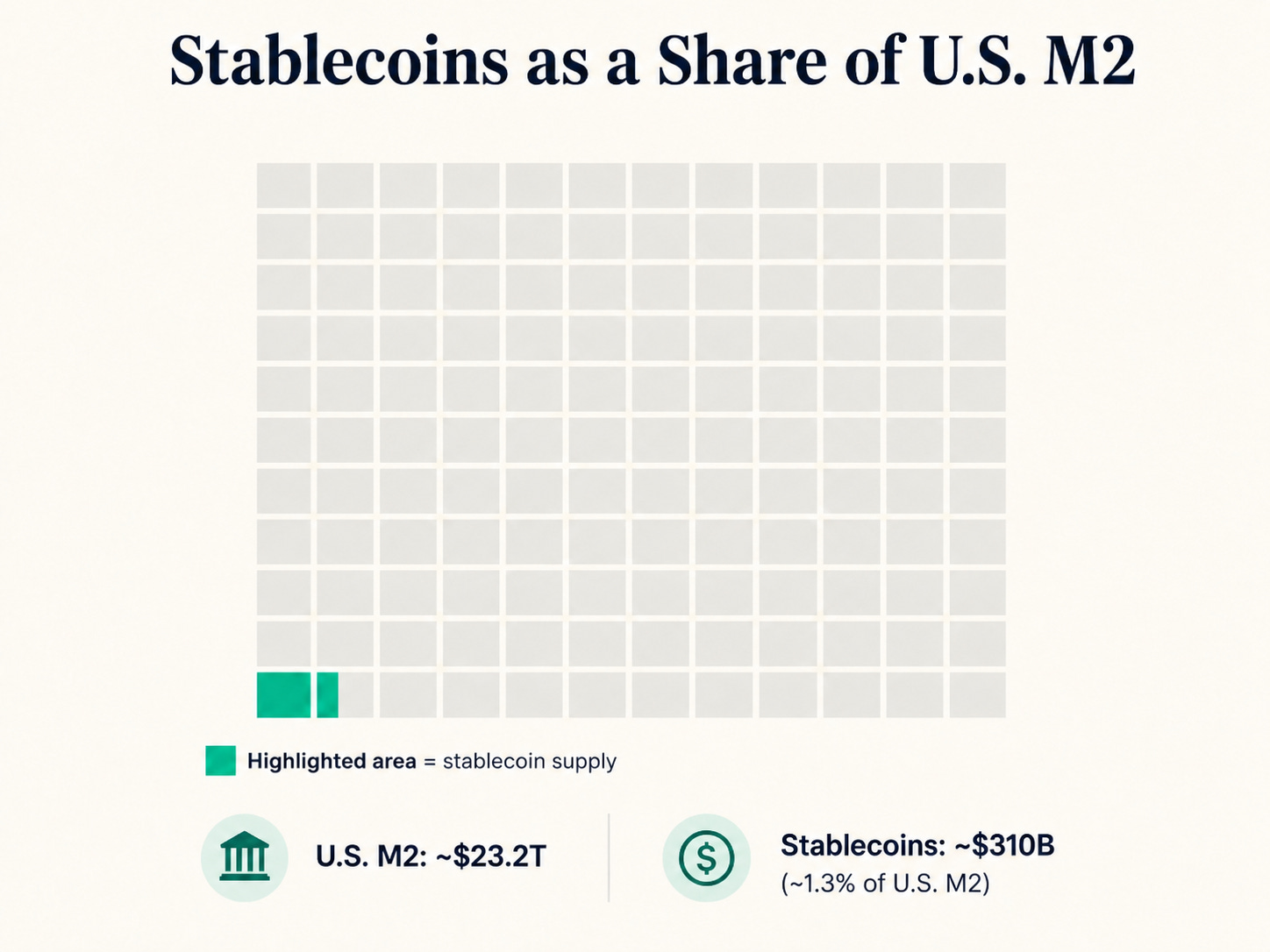
As of August 15, 2026, Artemis tracks approximately $311 billion of stablecoins in circulation. That is only about 1.3% of the current U.S. M2 stock, yet the amount of transaction activity supported by that relatively small monetary base is enormous.
Blockchain Capital estimates that approximately $270 billion of average stablecoin supply supported about $33 trillion of adjusted transaction volume in 2025, implying annual turnover of roughly 122 times.
Their decomposition attributes about $68 billion of annual payments and transfer activity, $34 billion of derivatives volume, $18 billion of decentralized exchange activity, $1 billion of lending originations, and $400 million of RWA activity to every $1 billion of stablecoin supply.
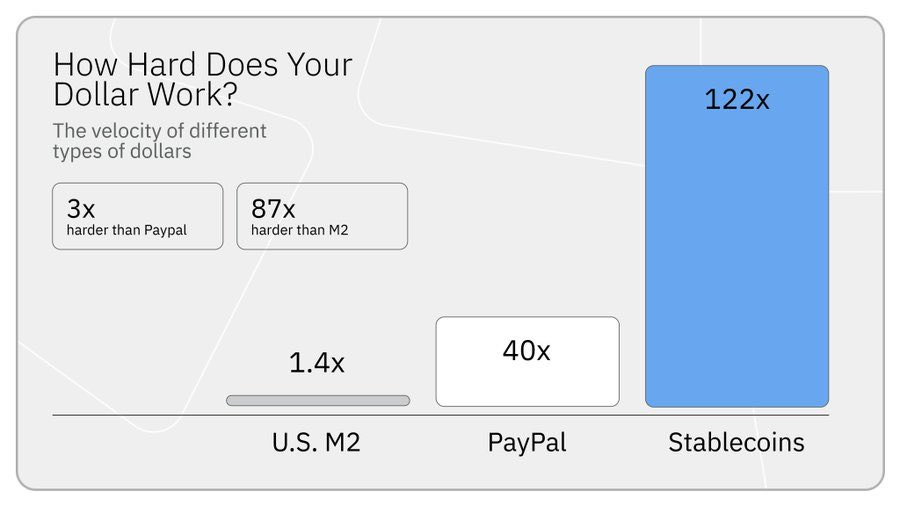
Federal Reserve M2 velocity uses final goods and services included in nominal GDP, while stablecoin turnover measures transfers across a financial network. The two therefore capture different categories of economic activity and should not be treated as directly equivalent.
Tokenized dollars demonstrate that a monetary asset can support dramatically greater transaction throughput when it becomes continuously available, programmable, and reusable.
A stablecoin can arrive as payment and immediately enter another economic process. It can move into a liquidity venue, finance a position, serve as collateral, settle an obligation, or be transferred into a yield-bearing asset. Each transition can occur through software running on continuously operating infrastructure.
When settlement approaches the speed of computation, capital acquires one of software’s most important properties: immediate reuse.
This is a useful way to think about the broader significance of blockchains. Their economic contribution may ultimately have less to do with reducing the nominal cost of an individual payment than with reducing the amount of time capital remains economically inactive between payments.
A faster dollar is a more productive dollar.
The Velocity of Assets
Stablecoins are the clearest demonstration of what happens when money becomes native to programmable infrastructure, but the same logic applies to almost every financial asset. Once an asset can be represented as software, the functions surrounding that asset, including issuance, transfer, settlement, custody, collateralization, financing, and distribution, also become eligible for automation.
In traditional financial markets, an asset is usually embedded inside a network of institutions and databases that determine where it can trade, when it can settle, who can hold it, how it can be financed, and which other assets it can interact with. Each transition between these functions creates operational friction because ownership has to be recognized, communicated, and reconciled across separate systems.
Tokenization collapses more of those functions onto a common computational substrate. A tokenized asset can be represented in a form that software can verify, transfer, price, divide, collateralize, and combine with other assets. Settlement can occur continuously, ownership can update programmatically, and financial applications can interact with the asset directly rather than relying on a chain of intermediaries to reproduce the same information across multiple ledgers.
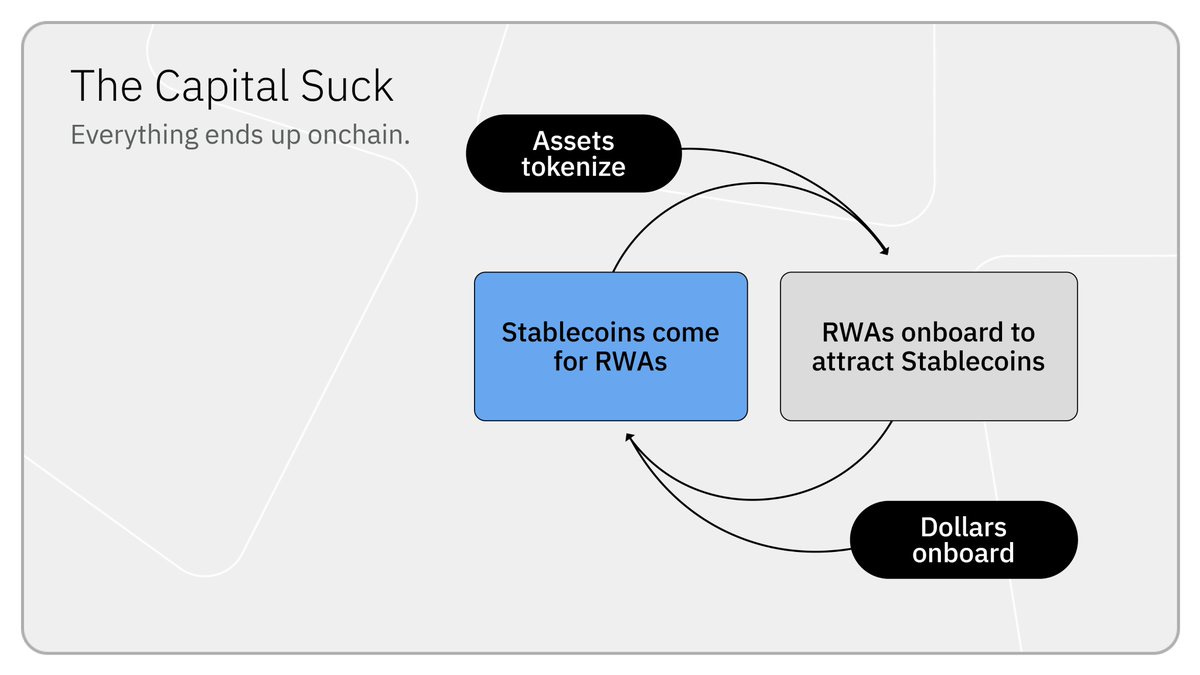
Once cash becomes programmable, investors want programmable assets to hold against it. Once those assets exist, lenders want to accept them as collateral. Trading venues want access to the resulting liquidity. Developers build products around those markets, and issuers gain access to a broader base of programmable capital.
Each new asset makes the surrounding ecosystem more useful, which increases the incentive for the next asset to join it.
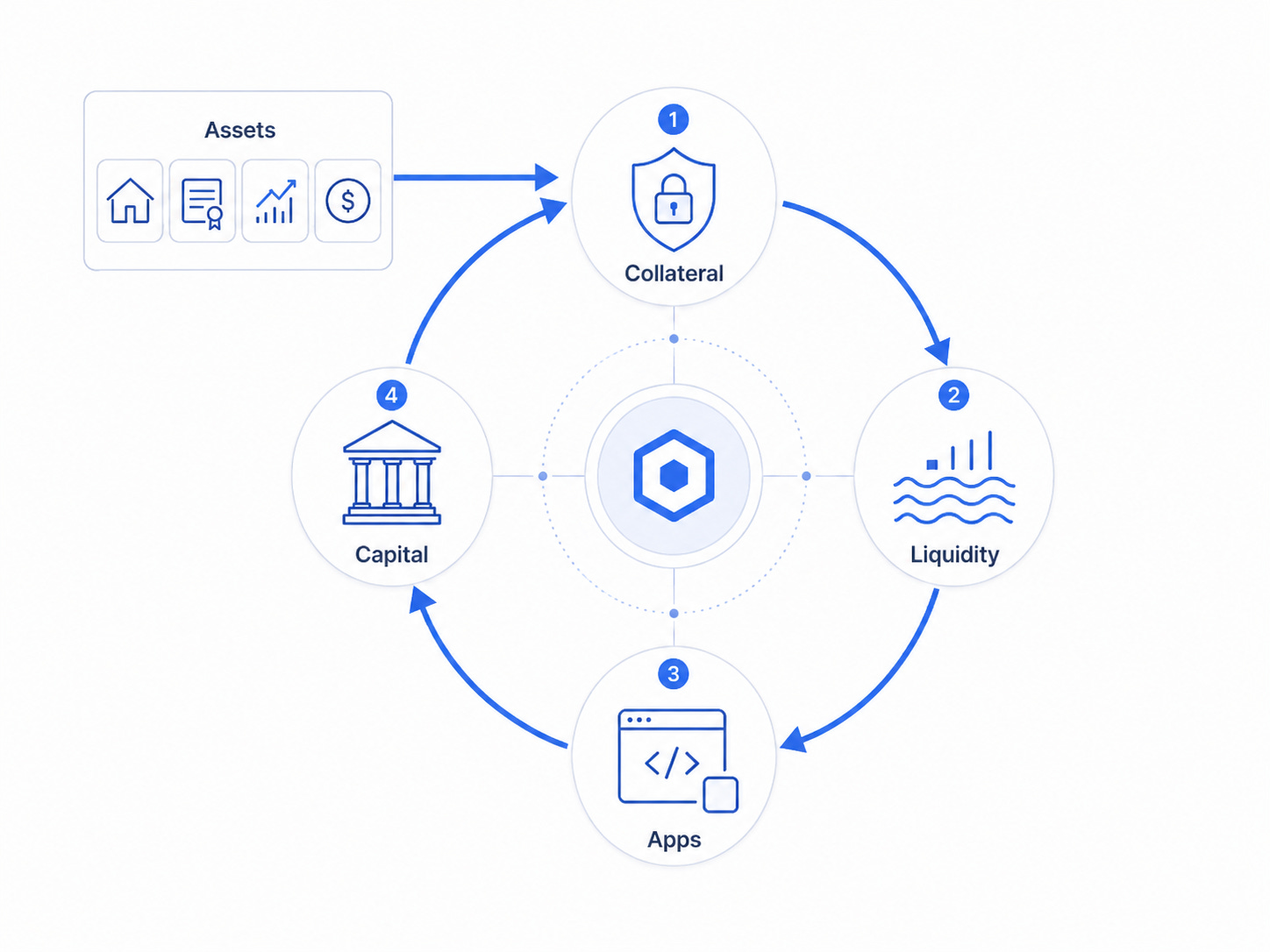
This is why tokenization is self-reinforcing. The decision to tokenize an asset is initially about reducing friction around that specific asset, but the larger advantage comes from joining a financial environment in which more forms of capital can interact directly. As that environment becomes deeper and more liquid, remaining outside it carries a growing opportunity cost.
Everything that can benefit from faster settlement, broader distribution, programmable ownership, or greater collateral utility acquires an economic reason to become tokenized.
The process will move at different speeds across asset classes because regulation, legal enforceability, market structure, and custody requirements vary considerably. Some assets will remain difficult or uneconomic to tokenize for a long time.
We can already see that process unfolding across government bonds, money market funds, private credit, equities, deposits, commodities, and payment settlement. As of August 2026, RWA.xyz tracks approximately $38.1 billion of distributed tokenized real-world assets, excluding stablecoins, held across nearly two million asset holders.
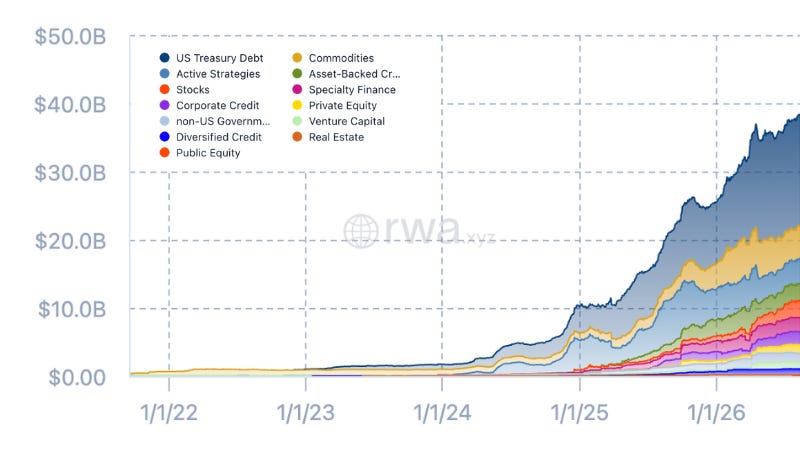
Tokenized U.S. Treasury products alone account for approximately $16.2 billion across 65 products and more than 55,000 holders.
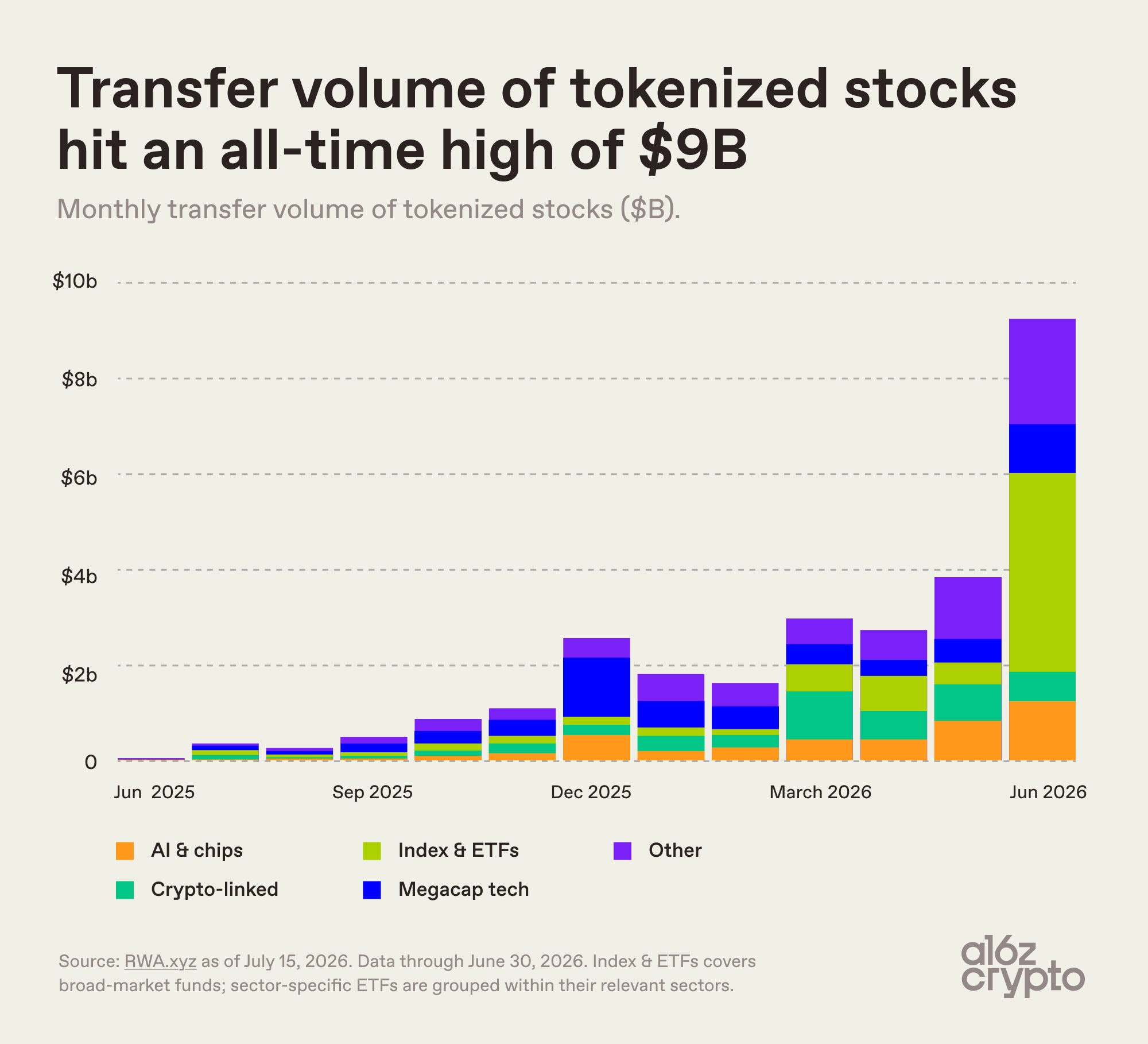
Tokenized equities are also beginning to show meaningful transaction activity. According to a16z crypto, monthly transfer volume for tokenized stocks reached an all-time high of roughly $9 billion in June 2026, rising from well under $1 billion a year earlier.
The growth was broad-based across index and ETF products, megacap technology stocks, crypto-linked equities, and AI & semiconductors.
Traditional financial institutions are also moving settlement activity onto these rails. Visa reported in April 2026 that its stablecoin settlement pilot had reached a $7 billion annualized run rate, growing 50% quarter over quarter, and had expanded to nine blockchain networks. Visa has also begun offering seven-day-a-week stablecoin settlement for selected participants.
The BIS increasingly frames tokenization in similar terms. Its 2025 Annual Economic Report describes a potential financial architecture built around tokenized central bank reserves, commercial bank money, and government bonds on a unified ledger. The BIS argues that programmability and composability can integrate sequences of financial transactions while reducing delays, manual interventions, and reconciliation created by separating messaging, clearing, and settlement.
The direction of travel is becoming increasingly clear even if the final architecture remains unsettled. Public blockchains, permissioned ledgers, tokenized bank deposits, stablecoins, and central-bank settlement assets may coexist in different parts of the financial system.
Stablecoins increased the possible velocity of money. Tokenization extends the same logic across the balance sheet.
The Velocity of Intelligence
Capital is only one source of latency in an economy. Another is coordination.
Nearly every economic transaction contains a chain of cognitive tasks that surround the movement of money. Someone has to identify a need, search for providers, compare alternatives, assess risk, negotiate terms, authorize spending, monitor performance, reconcile the outcome, and decide what should happen next. These activities are expensive because human attention is expensive.
Ronald Coase built one of the foundational theories that markets have transaction costs, including search, negotiation, contracting, and monitoring, and firms emerge partly because internal coordination can sometimes perform these activities more efficiently than repeated market transactions. AI changes this equation because many forms of coordination can increasingly be performed by software.
The early productivity evidence already shows meaningful effects at the task level. A controlled experiment published in Science found that professionals using generative AI completed writing tasks 40% faster while producing output rated 18% higher in quality. In software development, an experimental study of GitHub Copilot found that developers completed a standardized programming task 55.8% faster when using the AI tool. These studies evaluate specific tasks rather than autonomous economic agents, but they provide empirical evidence that software can already compress the time required for important categories of cognitive work.
The agentic model extends that productivity effect from assistance into coordination. An agent can potentially search a market, evaluate available suppliers, interpret documentation, compare pricing, invoke services, monitor outcomes, and allocate a budget within a single software process.
Researchers Peyman Shahidi, Gili Rusak, Benjamin Manning, and Andrey Fradkin describe the potential economic implications through the concept of a “Coasean Singularity,” asking what happens to demand, supply, firms, and market design when AI agents dramatically reduce the costs associated with market participation.
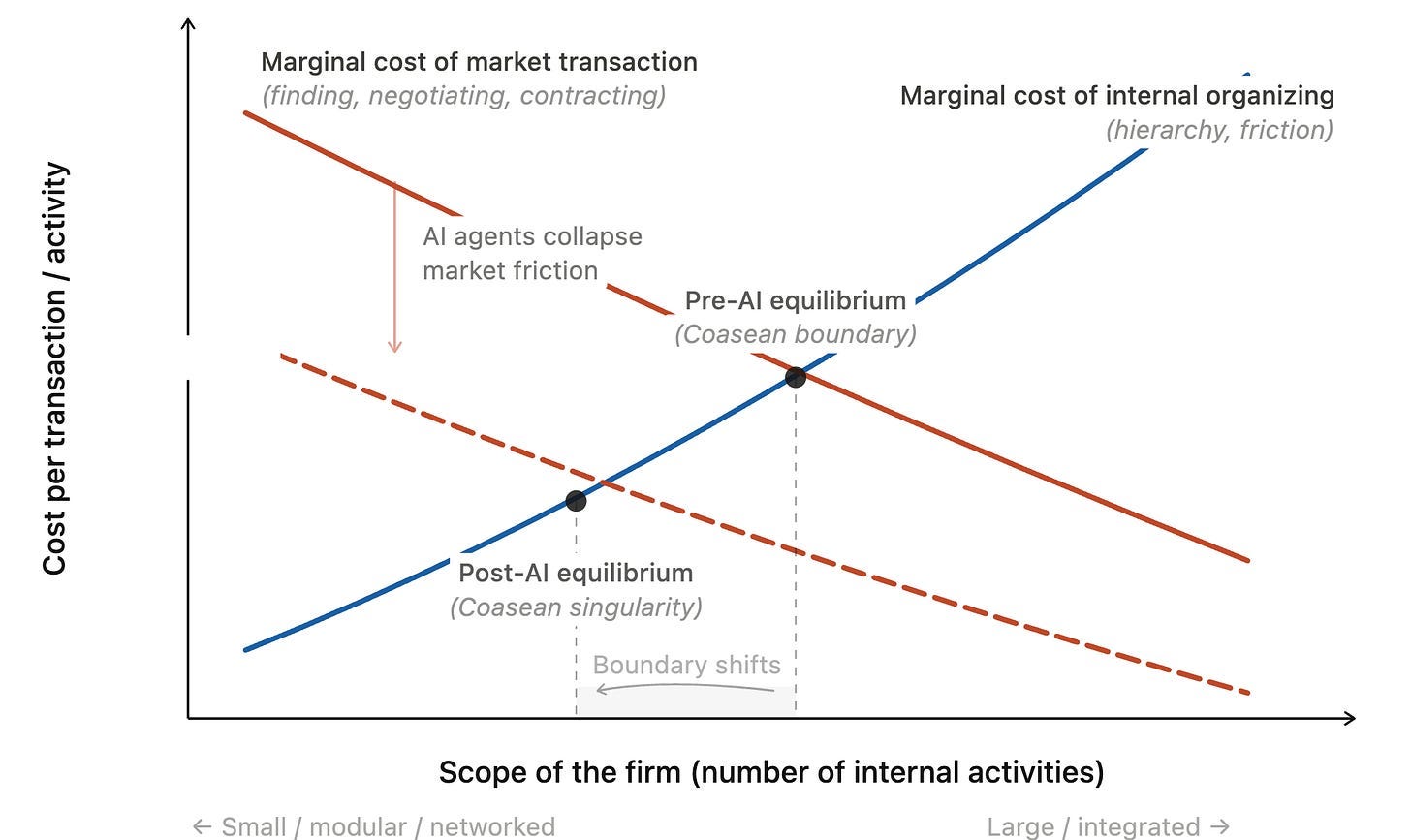
This is the economic framing that makes agents interesting beyond productivity software. AI is a transaction-cost technology.
A model that helps an employee write an email faster creates incremental productivity. An agent that can continuously search markets, purchase resources, evaluate outcomes, and redirect capital begins to alter the mechanism through which economic activity is coordinated.
Yet intelligence alone cannot complete that loop. An agent operating at machine speed still encounters financial infrastructure built around accounts, credentials, payment approvals, banking windows, settlement delays, and reconciliation. The cognitive portion of a transaction may take milliseconds while the financial portion can take hours or days. Programmable money closes that gap.
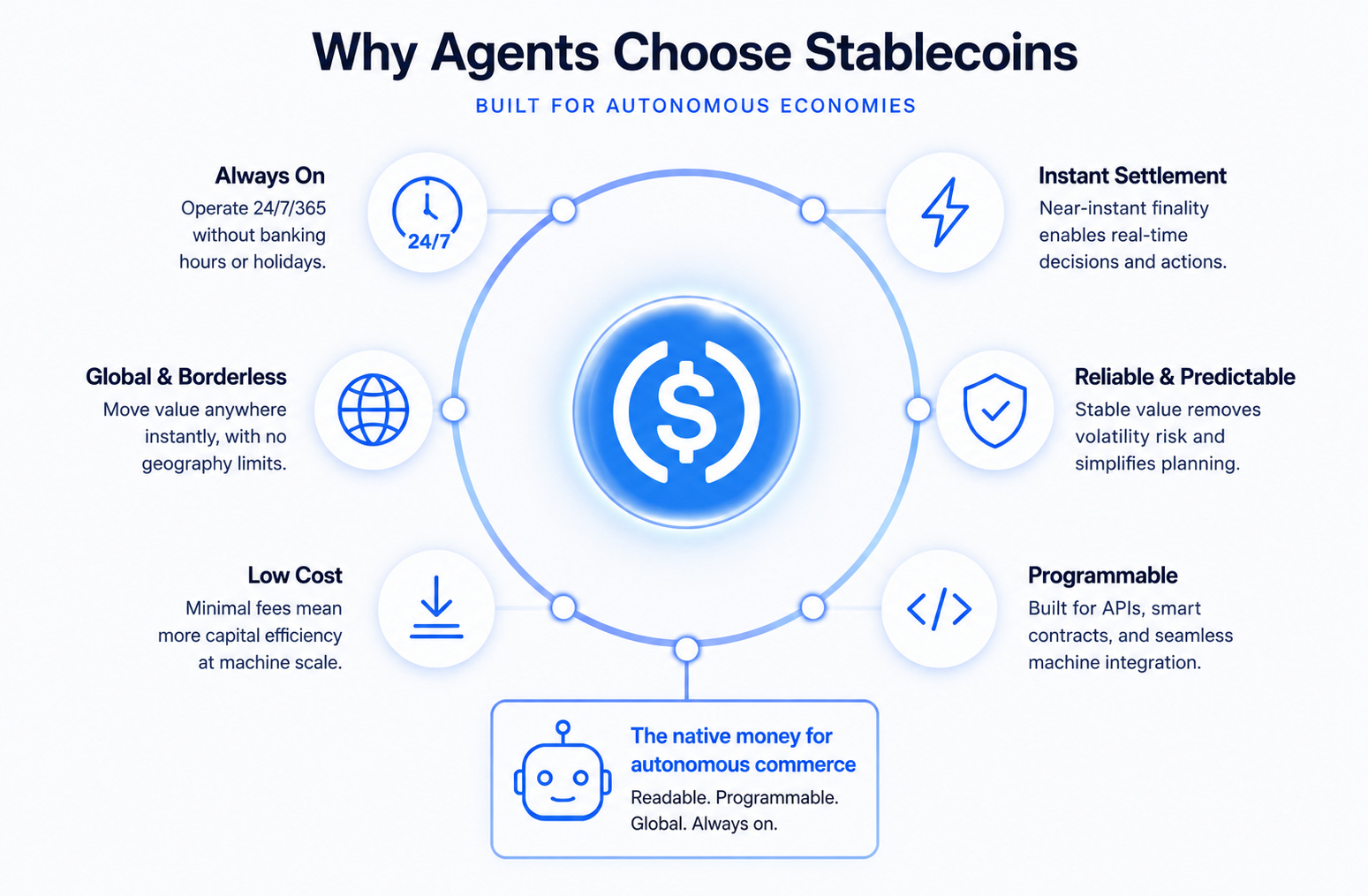
Once an agent can control a tokenized balance within user-defined limits, the entire sequence can become machine executable. The agent can identify a resource, assess its value, purchase it, confirm delivery, and determine what to do with the remaining capital. Once intelligence can spend, economic intent becomes executable.
We can already see an early version of this architecture developing around APIs. Circle’s Agent Marketplace currently contains more than 900 paid services that agents can call without creating separate accounts, paying per request from a stablecoin balance. Circle also reports that 99.3% of settlement volume using the x402 payment protocol was denominated in USDC as of July 2026, while USDC itself has surpassed $96 trillion in cumulative onchain transaction volume.
These figures are still early relative to global software and payment markets, but the architecture is worth paying attention to. The commercial workflow around an API has traditionally required discovery, account creation, credentials, pricing plans, billing systems, payment methods, and reconciliation. Machine-native payments allow a service to attach a price directly to a request with tools like Routavo.
The resulting transaction can become remarkably compact:
discover → evaluate → call → pay → verify → repeat
That compression has consequences beyond convenience because it changes the economics of transaction size.
A company rarely sends a procurement team to purchase three cents of data. A treasury desk does not manually optimize five dollars of collateral every sixty seconds. Businesses do not contract with specialists for twelve seconds of work. Banks do not originate thirty-second working-capital loans. The useful economic activity may exist, but the fixed cost of coordinating it makes the transaction irrational.
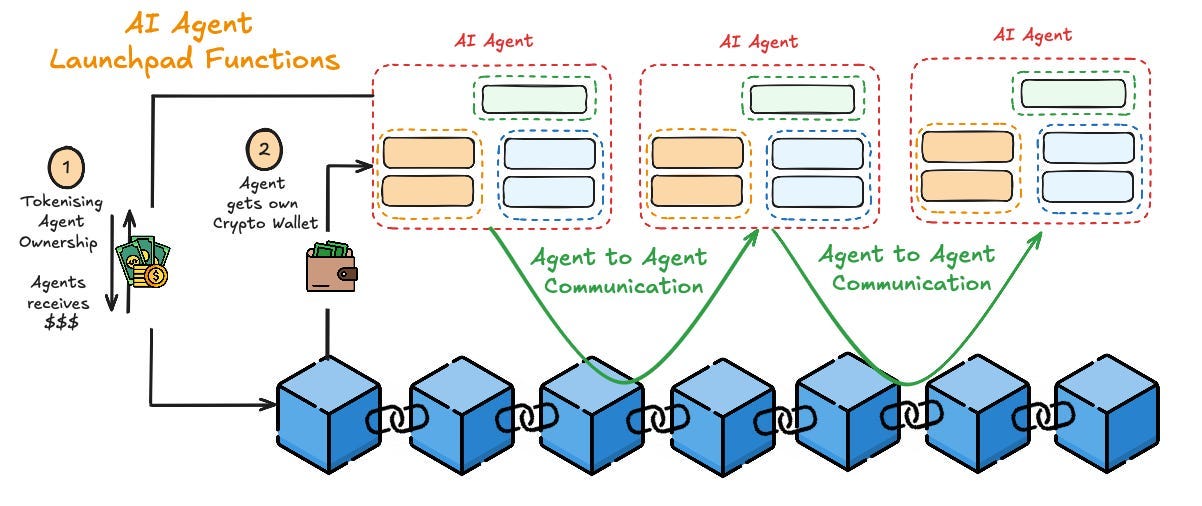
Agents can compress the coordination cost. Programmable assets can compress the settlement cost. When both decline together, the minimum amount of value required to justify a transaction declines with them.
That may become one of the most important economic effects of AI and tokenization because things like smaller transaction sizes allow entirely new markets to form. Compute can be bought by the second. Proprietary data can be purchased by the query. Model inference can be acquired by the task. Liquidity can be rented for an extremely short interval. Specialized intelligence can be purchased for one step inside a larger workflow.
The Velocity of Everything
The implications become much larger when these trends are all brought together. Tokenization on blockchain technology increases the velocity and utility of capital, while AI increases the speed at which economic decisions can be made. Agents connect the two by turning intelligence into an economic actor that can continuously search, decide, transact, and allocate resources.
The agentic economy changes the number of participants capable of taking economic action. For most of history, economic activity has ultimately been constrained by the number of humans and organizations available to make decisions.
A person can compare only so many products, negotiate with only so many counterparties, monitor only so many investments, and initiate only so many transactions in a day. Software agents weaken that constraint because one person or company can deploy many autonomous processes simultaneously, each operating continuously and at very low marginal cost.
We are already beginning to see the internet move in this direction. Cloudflare reported in July 2026 that automated bots were generating roughly 57% of web requests, meaning machine-generated requests had surpassed human requests on its network. During the company’s second-quarter earnings call, CFO Thomas Seifert went considerably further, estimating that if current trends continue, non-human internet traffic could become as much as 1,000 times human traffic within five years. Reuters separately reported that Cloudflare raised its annual revenue outlook as the rapid growth of AI agents increased demand across its network and cloud infrastructure.
The internet is shifting from an environment in which humans generate most requests to one in which machines increasingly act on behalf of humans, companies, and other machines. The agent economy increases economic capacity by increasing the number of entities capable of acting on information.
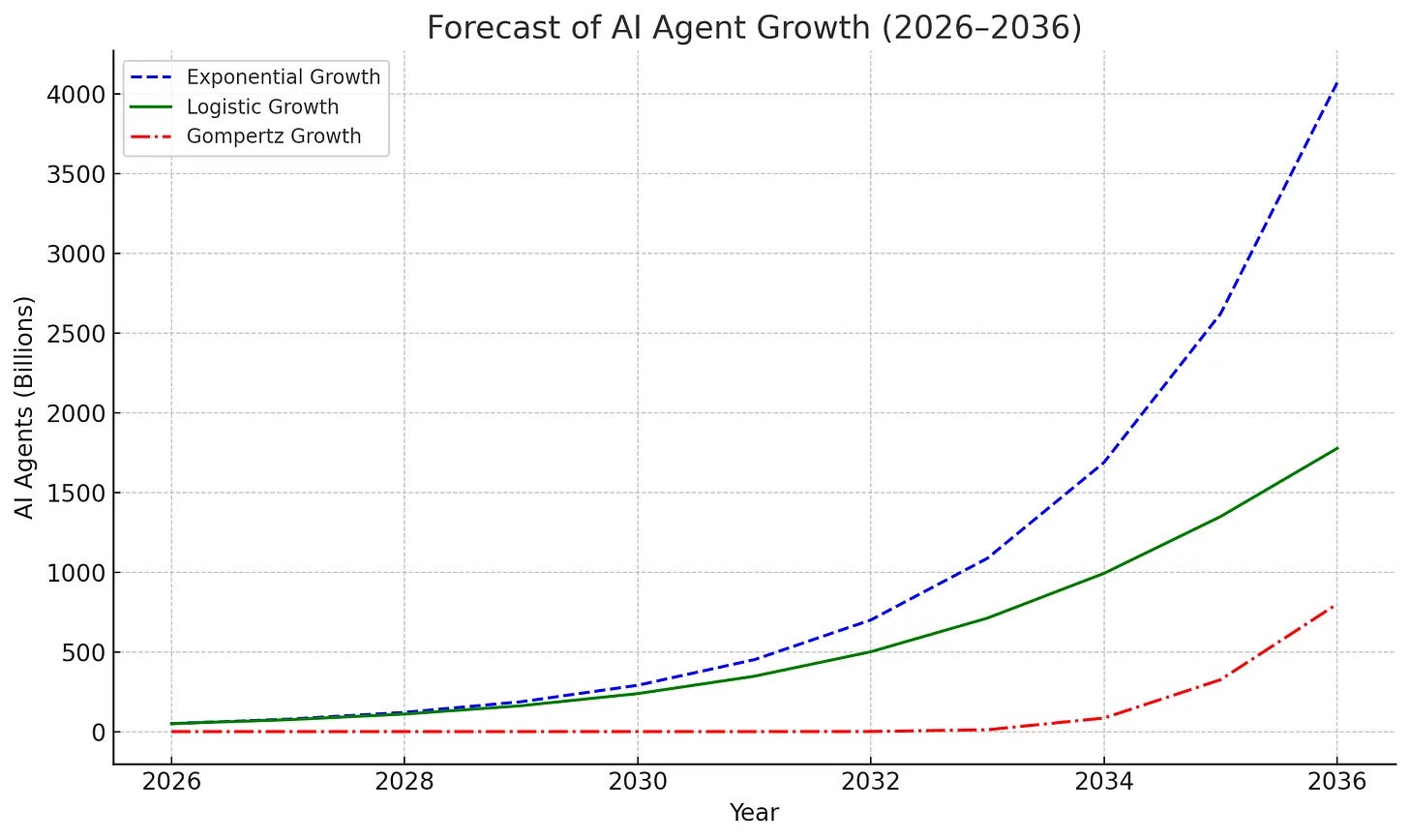
Consider what happens when a person asks an agent to purchase a camera. A human might visit five websites, compare several products, and make one purchase. An agent can inspect thousands of listings, query inventory across multiple merchants, compare financing and shipping options, evaluate historical pricing, check warranty terms, and potentially negotiate with other software before executing the transaction. One unit of human intent can generate thousands of machine actions.
The same multiplication applies across the economy. A corporate procurement agent can continuously search suppliers and renegotiate purchases as prices change. A treasury agent can monitor cash flows and move idle balances into yield-bearing assets throughout the day. A portfolio agent can evaluate thousands of securities, adjust collateral, hedge exposures, and rebalance positions as market conditions evolve. A logistics agent can continuously purchase transportation, warehousing, insurance, compute, and data based on real-time demand.
Agents can also appear on the supply side of these markets. A specialized agent might sell research, software development, model inference, data analysis, liquidity, compute, or some other narrowly defined capability to thousands of other agents simultaneously. The cost of creating and operating an additional economic participant can therefore fall dramatically.
Historically, increases in economic output have depended heavily on increasing the productivity of existing workers and capital. Agents introduce another mechanism because software can create additional decision-making capacity at extremely low marginal cost.
For the first time, the supply of economically active intelligence can scale much faster than the human population. That intelligence will require an economic system capable of operating at the same frequency.
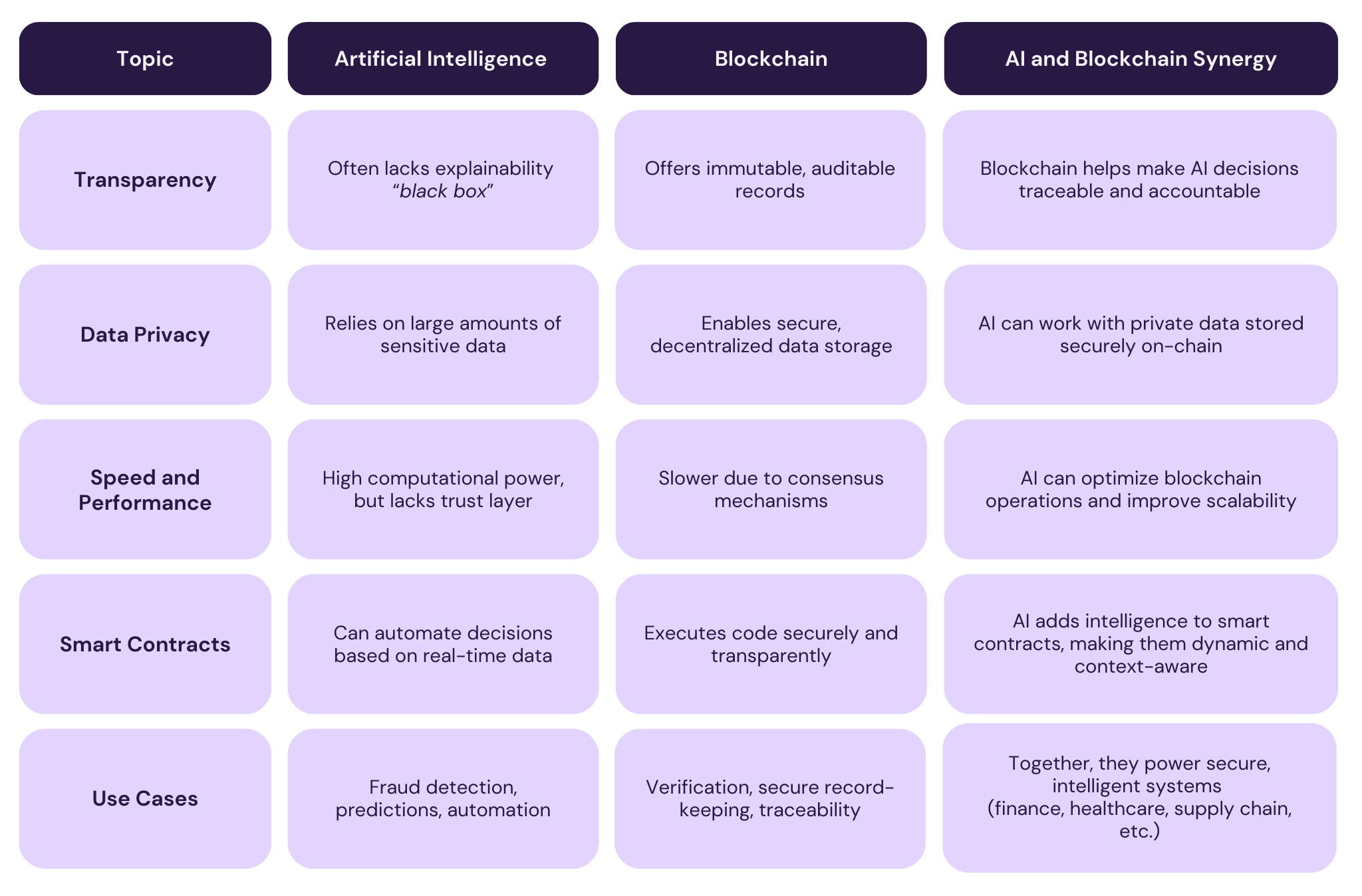
Taking a closer look at today’s payment and asset infrastructure, which was designed for a world in which humans initiate relatively few transactions. Account opening, payment authorization, reconciliation, settlement schedules, transaction minimums, and institutional operating hours are manageable when a person makes a handful of purchases or financial decisions each day. They become significant bottlenecks when a single agent may need to make thousands of economic decisions across many counterparties. A machine economy therefore creates unusually strong demand for machine-native money and assets.
In an essay for the World Economic Forum, Circle CEO Jeremy Allaire describes blockchains as an emerging economic operating system in which money, assets, and contracts can exist as globally accessible, programmable, and interoperable internet objects. He argues that autonomous agents will need to contract, provision resources, make purchases, fulfill tasks, manage value, enter agreements, and allocate capital, which requires underlying infrastructure capable of supporting those activities programmatically. This is where the stablecoin and tokenization arguments converge with the agentic economy.
Once these components begin to exist together, the efficiency gains begin to compound. Imagine a corporate treasury agent that receives a stablecoin payment from a customer. The agent knows that the company does not need the money for six hours, so it allocates the balance into a tokenized Treasury product. Thirty minutes later, another agent identifies an inventory opportunity with an expected return above the Treasury yield.
The same capital can participate in a sequence of productive activities that would have required multiple institutions, systems, approvals, and settlement periods under conventional infrastructure.
As agents become more capable, these optimization loops can operate continuously across entire organizations. Cash management, procurement, credit, inventory, pricing, investment, logistics, and settlement are increasingly connected because the software that makes one decision can immediately act on the financial consequences of that decision.
This also creates economic activity that barely exists today. When millions or billions of agents can discover and transact with one another, markets become viable at transaction sizes and frequencies that humans cannot economically manage.
An agent might purchase one database record for a fraction of a cent, rent additional compute for twelve seconds, acquire one specialized model inference, buy five minutes of liquidity, or pay another agent to perform a small part of a larger task. Each individual transaction may have trivial value, but billions of such transactions can collectively represent meaningful economic activity.
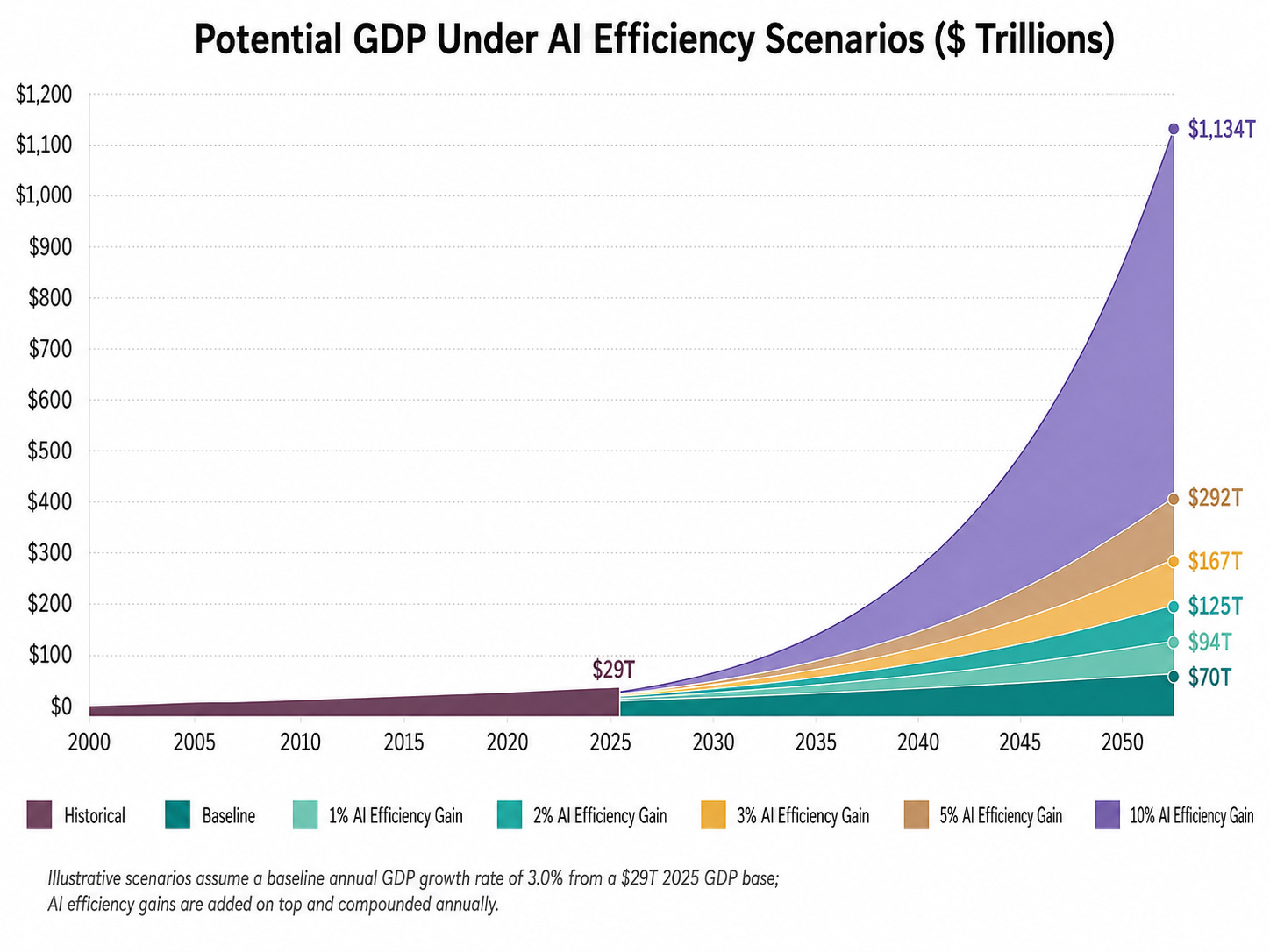
AI and programmable capital can produce a comparable effect for economic activity. When the cost of coordination and settlement falls far enough, the economy gains resolution. From a GDP perspective, even 1% of efficiency gains leads to massive growth in the long run. Bigger efficiency gains could lead to even more exponential GDP growth.
Tasks that were too small to outsource can become markets. Assets that were too difficult to finance can become collateral. Capital that was too costly to optimize can be continuously allocated. Services that were too inexpensive to invoice can be sold individually. Economic interactions that once required companies, contracts, employees, and payment departments can increasingly be compressed into software requests.
The consequences extend well beyond finance because almost every industry ultimately consists of decisions followed by resource allocation. Manufacturing allocates materials and production capacity. Logistics allocates vehicles and inventory. Advertising allocates attention and budgets. Energy markets allocate electricity. Cloud computing allocates processors and storage. Financial markets allocate capital and risk.
Agents can increasingly participate in each of these allocation processes. Tokenized infrastructure gives those agents a common language for ownership and value exchange. Stablecoins give them a medium of settlement. APIs give them access to external capabilities. AI gives them the ability to reason about which resources should be acquired and how they should be used.
The result is an economy with many more economic actors, each capable of operating much faster than the humans and institutions that preceded them.
Now let’s bring it all together.
This is where velocity becomes a useful way to understand the entire transition. The velocity of money increases because capital can settle and be reused faster. The velocity of assets increases because ownership becomes programmable and assets can move between more economic states. The velocity of intelligence increases because agents can evaluate and act on opportunities continuously. The number of transactions increases because the cost of coordinating and settling each transaction declines.
Economic velocity compounds when faster intelligence controls faster capital. The internet showed what happens when the marginal cost of distributing information approaches zero. Information production exploded because billions of people and machines could publish, copy, search, and consume information at unprecedented scale. The agent economy introduces a similar dynamic into economic action. Machines will increasingly search, negotiate, purchase, sell, borrow, lend, invest, provision, and coordinate on behalf of people and organizations.
If non-human traffic eventually does become hundreds or even a thousand times larger than human traffic, an enormous share of internet activity will consist of machines interacting with machines. As those interactions evolve from information retrieval into economic action, the architecture of the internet will increasingly need to support machine-native payments, ownership, contracts, identity, and settlement.
The economic system underneath the internet will have to become as programmable as the intelligence operating on top of it. The future economy will have more participants, making more decisions, executing more transactions, across more assets, at a frequency that human institutions were never designed to support.
That is the connection between stablecoins, tokenization, APIs, and agents. Each removes a different constraint on economic activity. Stablecoins increase the speed at which money can move. Tokenization expands what capital can interact with. APIs expose economic capabilities to software. Agents dramatically increase the number and frequency of decisions that can call those capabilities.
As these technologies converge, the time between observing an opportunity, deciding to act, moving capital, and beginning the next transaction continues to shrink closer to zero. And that is a future that benefits everyone.
Until our next adventure.
Disclaimer: This month’s edition of The API Economy has no direct affiliation with Circle or any other company mentioned. I am employed by Circle at the time of this writing, but the views in this essay are my own personal opinions and don’t necessarily represent the views of Circle.
Note: Thanks to everyone who has consistently conducted quality stablecoin and AI research, including but not limited to — Jeremy Allaire, Nic Carter, Jon Ma (and the entire Artemis team), Danny Organ, and Jonah.
*Special thanks to Mama Schroeder for editing this essay (any typos are on her 😊).